
Article Categories
- All Categories
-
 Data Structure
-
 Networking
-
 RDBMS
RDBMS
-
 Operating System
-
 Java
Java
-
 MS Excel
-
 iOS
iOS
-
 HTML
HTML
-
 CSS
CSS
-
 Android
-
 Python
-
 C Programming
-
 C++
C++
-
 C#
C#
-
 MongoDB
-
 MySQL
MySQL
-
 Javascript
-
 PHP
PHP
-
 Economics & Finance
Local Area Networks
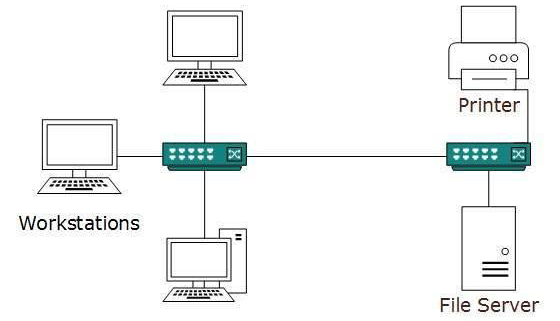
A Local Area Network (LAN) is a private network that connects computers and devices within a limited area like a residence, an office, a building, or a campus. On a small scale, LANs are used to connect personal computers to printers. However, LANs can also extend to a few kilometers when used by companies, where a large number of computers share a variety of resources like hardware (e.g., printers, scanners, audiovisual devices), software (e.g., application programs), and data.
Distinguishing Features of LAN
-
Limited geographic scope − Network size is limited to a small geographical area, presently to a few kilometers.
-
High data transfer rate − Data transfer rates are generally high, ranging from 100 Mbps to 1000 Mbps.
-
Single transmission medium − In general, a LAN uses only one type of transmission medium, commonly Category 5 twisted pair cables.
-
Defined topology − A LAN is distinguished from other networks by its topology. The common topologies are bus, ring, mesh, and star.
-
Limited scalability − The number of computers connected to a LAN is usually restricted, making LANs limitedly scalable.
-
Ethernet standard − IEEE 802.3 or Ethernet is the most common LAN standard. It uses a wired medium in conjunction with a switch or a hub. Originally, coaxial cables were used for communication, but now twisted pair cables and fiber optic cables are also used. Ethernet speed has increased from 2.94 Mbps to 400 Gbps.
Wireless LANs (WLAN)
Wireless LANs use high-frequency radio waves instead of cables for communication. They provide clutter-free homes, offices, and other networked places. WLANs use an Access Point (AP), a wireless router, or a base station for transferring packets between wireless computers and the internet. Most WLANs are based on the standard IEEE 802.11, commonly known as WiFi.
WiFi operates on the 2.4 GHz and 5 GHz frequency bands. The latest standard, WiFi 6 (802.11ax), offers speeds up to 9.6 Gbps and improved performance in dense environments.
Virtual LANs (VLAN)
Virtual LANs are a logical group of computers that appear to be on the same LAN irrespective of the configuration of the underlying physical network. Network administrators partition the network to match the functional requirements of VLANs, so that each VLAN comprises a subset of ports on a single or multiple switches. This allows computers and devices on a VLAN to communicate in a simulated environment as if they were on a separate physical LAN.
For example, in a company building, the finance and engineering departments can each be placed on separate VLANs even if they share the same physical switch. This improves security and reduces broadcast traffic.
Comparison of LAN Types
| Feature | Wired LAN (Ethernet) | Wireless LAN (WLAN) | Virtual LAN (VLAN) |
|---|---|---|---|
| Medium | Cables (twisted pair, fiber) | Radio waves (WiFi) | Logical over physical LAN |
| Standard | IEEE 802.3 | IEEE 802.11 | IEEE 802.1Q |
| Speed | Up to 400 Gbps | Up to 9.6 Gbps (WiFi 6) | Depends on underlying LAN |
| Security | High (physical access needed) | Moderate (encryption required) | High (traffic isolation) |
| Mobility | Fixed | Mobile within range | Fixed or mobile |
Conclusion
A Local Area Network connects computers and devices within a limited area for sharing resources and data. Wired Ethernet LANs offer the highest speeds and reliability, WLANs provide wireless convenience using WiFi, and VLANs enable logical network segmentation without changing physical infrastructure. Together, these LAN types form the foundation of modern networking in homes, offices, and enterprises.

18K+ Views