
- Go - Home
- Go - Overview
- Go - Environment Setup
- Go - Program Structure
- Go - Basic Syntax
- Go - Data Types
- Go - Variables
- Go - Constants
- Go - Identifiers
- Go - Keywords
- Go Operators
- Go - Operators
- Go - Arithmetic Operators
- Go - Assignment Operators
- Go - Relational Operators
- Go - Logical Operators
- Go - Bitwise Operators
- Go - Miscellaneous Operators
- Go - Operators Precedence
- Go Decision Making
- Go - Decision Making
- Go - If Statement
- Go - If Else Statement
- Go - Nested If Statements
- Go - Switch Statement
- Go - Select Statement
- Go Control Flow Statements
- Go - For Loop
- Go - Nested for Loops
- Go - Break Statement
- Go - Continue Statement
- Go - Goto Statement
- Go Functions
- Go - Functions
- Go - Call by Value
- Go - Call by Reference
- Go - Functions as Values
- Go - Function Closure
- Go - Function Method
- Go - Anonymous function
- Go Strings
- Go - Strings
- Go - String Length
- Go - String Concatenation
- Go - Compare Strings
- Go - Split String
- Go - Substring Extraction
- Go - String Replacement
- Go - String Interpolation
- Go - Parse Date Strings
- Go - Pointers
- Go - Pointers
- Go - Array of pointers
- Go - Pointer to pointer
- Go - Passing pointers to functions
- Go Advanced Control Structures
- Go - Scope Rules
- Go - Dereferencing Pointer
- Go - Structures
- Go - Slice
- Go - Slice of Slices
- Go - Range
- Go - Maps
- Go - Recursion
- Go - Type Casting
- Go - Interfaces
- Go - Type Assertion
- Go - Error Handling
- Go - Concurrency
- Go - Regular Expression
- Go - Inheritance
- Go - Packages
- Go - Templates
- Go - Reflection
- Go - Generics
- Go File Handling
- Go - Read File By Word
- Go - Read File By Line
- Go - Read CSV Files
- Go - Delete File
- Go - Rename & Move File
- Go - Truncate a File
- Go - File Read-Write Mode W/O Truncation
- Go Miscellaneous
- Go - defer Keyword
- Go - Fmt Package
- Go - Zero Value
- Go - Import
- Go Useful Resources
- Go - Questions and Answers
- Go - Cheatsheet
- Go - Quick Guide
- Go - Useful Resources
- Go - Discussion
- Go - Online Compilers
Go - Decision Making
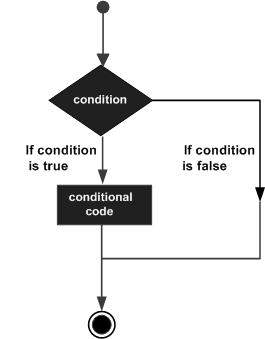
Decision making structures require that the programmer specify one or more conditions to be evaluated or tested by the program, along with a statement or statements to be executed if the condition is determined to be true, and optionally, other statements to be executed if the condition is determined to be false.
Following is the general form of a typical decision making structure found in most of the programming languages −
Types of Decision Making Statements
Go programming language provides the following types of decision making statements. Click the following links to check their detail.
| Sr.No | Statement & Description |
|---|---|
| 1 |
if statement
An if statement consists of a boolean expression followed by one or more statements. |
| 2 | if...else statement
An if statement can be followed by an optional else statement, which executes when the boolean expression is false. |
| 3 |
nested if statements
You can use one if or else if statement inside another if or else if statement(s). |
| 4 |
switch statement
A switch statement allows a variable to be tested for equality against a list of values. |
| 5 |
select statement
A select statement is similar to switch statement with difference that case statements refers to channel communications. |
Example - Usage of If Statement
This example demonstrates how to use an if statement in Go to check a condition and execute a block of code when the condition is true.
main.go
package main

import "fmt"

func main() {
   /* local variable definition */
   var a int = 20

   /* check the boolean condition using if statement */
   if( a < 30 ) {
      /* if condition is true then print the following */
      fmt.Printf("a is less than 30\n" )
   }
   fmt.Printf("value of a is : %d\n", a)
}
Output
When the above code is compiled and executed, it produces the following result −
a is less than 30;
value of a is : 20