- Python Web - Django Framework
- Django Framework - Overview
- Django Framework - Users
- Django Framework - Installation
- Django Framework - Creating Application
- Python Web - Flask Framework
- Python Web - Flask Framework
- Flask Framework - Creating URL Routing
- Flask Framework - Using Templates
- Python Web - Pyramid Framework
- Python Web - Pyramid Framework
- Pyramid Framework - Core Concepts
- Pyramid Framework - Creating Application
- Python Web - Dash Framework
- Python Web - Dash Framework
- Dash Framework - App Layout
- Dash Framework - HTML Component
- Dash Framework - Visualization
- Python Web - py4web Framework
- Python Web - py4Web Framework
- py4web Framework - Dashboard
- py4web Framework - Creating Application
- Python Web - Miscellaneous
- Python Web - Web2py Framework
- Python Web - Choosing a Better Framework
- Python Web Development Libraries Resources
- Python Web - Quick Guide
- Python Web - Useful Resources
- Python Web - Discussion
Django Framework - Overview
In this chapter, we will discuss about Django Framework in detail.
Django is an MVT web framework that is used to build web applications. The huge Django web-framework comes with so many batteries included that developers often get amazed as to how everything manages to work together. The principle behind adding so many batteries is to have common web functionalities in the framework itself instead of adding latter as a separate library.
One of the main reasons behind the popularity of Django framework is the huge Django community. The community is so huge that a separate website was devoted to it where developers from all corners developed third-party packages including authentication, authorization, full-fledged Django powered CMS systems, e-commerce add-ons and so on. There is a high probability that what you are trying to develop is already developed by somebody and you just need to pull that into your project.
Why should you use Django?
Django is designed in such a way that encourages developers to develop websites fast, clean and with practical design. Djangos practical approach to getting things done is where it stands out from the crowd.
If youre planning to build a highly customizable app, such as social media website, Django is one of the best frameworks to consider. Django strength lies in its interaction between users or its ability to share different types of media. One of the great advantage of django is its ability to utilize large community-based support which gives you highly customizable third-party ready to use plugins in your applications.
Below are the top ten reasons to choose Django for web development −
Python
Python is arguably one of the easiest programming languages to learn because of its simple language constructs, flow structure and easy syntax. It is versatile and runs websites, desktop applications and mobile applications embedded in many devices and is used in other applications as a popular scripting language.
Batteries Included
Django comes with common libraries which are essential to build common functionalities like URL routing, authentication, an object-relational mapper (ORM), a templating system and db-schema migrations.
Built-in admin
Django has an in-built administration interface which lets you handle your models, user/ group permissions and to manage users. With model interface in place, there is no need for a separate database administration program for all but advanced database functions.
Doesnt get in your way
Creating a Django application adds no boilerplate and no unnecessary functions. Theres no mandatory imports, third-party libraries and no XML configuration files.
Scalable
Django is based on MVC design pattern. It means that all the entities like db (database), back-end and front-end code are individual entity. Django allows us to separate code from the static media including pictures, files, CSS and JavaScript that make up your site.
Django supports a full list of third-party libraries for web servers, caching, performance management, clustering and balancing. One of the advantages Django provides is the support for major email and messaging applications and services like ReST and OAuth.
Battle tested
Django was first open-sourced in 2005. After 12 years of growth, Django now not only runs news publishing websites but also runs all or part of major global enterprise like Pinterest, Instagram, Disqus, Bitbucket, EventBrite and Zapier. This makes it a robust and reliable web framework to work with.
Huge package support
Because of its large community support and huge developers network, there is a high possibility that whatever you intend to do might have been done before. Large international community of developers contribute to the community by releasing their projects as open-source packages.
One such repository of these projects is Django Package site. Currently, Django packages list over 3400 plus reusable Django apps, sites and tools to use in our Django projects.
Actively developed
One of the biggest risks associated with open source project is its sustainability. We cannot be sure if it lasts long.
There is no such risk with Django as it is 12 years old. Its consistent releases, newer/better versions and active community is growing every-day with a large core team of voluntary contributors who maintains and improve the code base every-day.
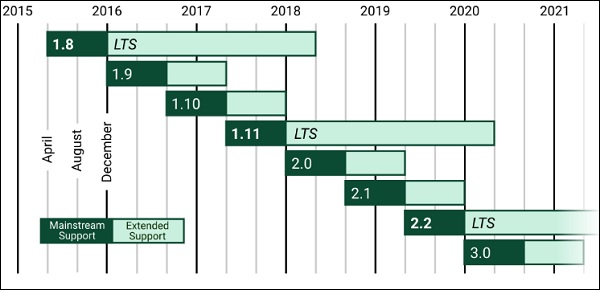
Stable releases
Open-source software projects like Django are, in many cases, actively developed and more secure than competing proprietary software as many developers are developing and testing it every day. However, the drawback of an open-source software project is the absence of a stable codebase to commercially viable development.
In Django, we have Long Term Support (LTS) versions of the software and a defined release process as shown in the below image −
First Class Documentation
From the very first release, Django developers made sure that there must be proper comprehensive documents available and the tutorials are easily understand.